
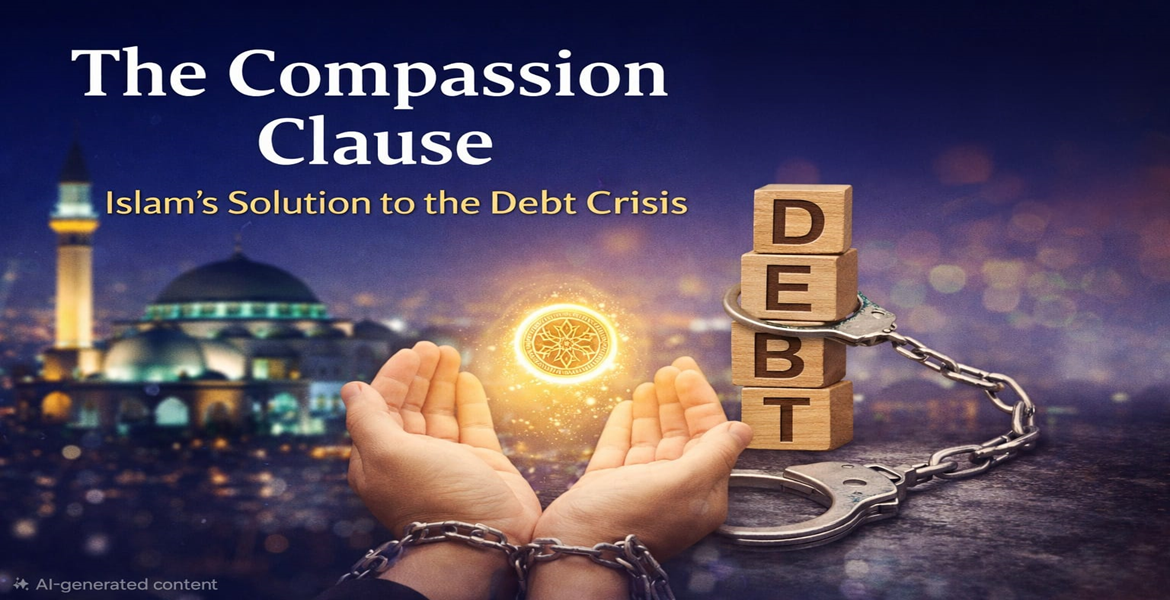
The Compassion Clause: Islam’s Solution to the Debt Crisis
- Post by: wp-islamicfinancereviewcouk
- December 30, 2025
- No Comment
In our previous post, we explored the Quran’s stern ultimatum on Riba—a declaration of spiritual war against exploitative interest. But divine justice is never solely about prohibition; it is equally about profound mercy and practical solutions. After establishing the rule, the Quran immediately presents a revolutionary ethical framework for handling the most vulnerable moment in any financial system: when a debtor faces genuine hardship.
This framework is found in a single, transformative verse that redefines the entire lender-borrower relationship. Surah Al-Baqarah, Verse 280 offers what we can call “The Compassion Clause”—an Islamic solution to debt crisis that prioritizes human dignity over financial contract.
The Verse of Mercy: A Command, Not a Suggestion
The command is clear, concise, and uncompromising in its compassion:
“And if someone is in hardship, then [let there be] postponement until a time of ease. But if you give [from your right as] charity, then it is better for you, if you only knew.” (Quran 2:280)
This is not presented as optional kindness; it is a divine injunction. Let’s break down its two-tiered approach to crisis management.
Tier 1: Mandatory Postponement (Al-Nasi’ah) – A Financial Safety Net
The first command establishes a mandatory social safety net: “postponement until a time of ease.”
Why Postponement is Obligatory
Unlike modern bankruptcy—a complex legal procedure often seen as a failure—Islamic postponement is a right of the debtor and a duty of the creditor. The Arabic term used (maysarah, “a time of ease”) implies the creditor must wait until the debtor’s circumstances genuinely improve, not until an arbitrary calendar date.
This prevents the vicious cycles we see today: predatory late fees, compounding interest on arrears, asset seizure, and the psychological devastation that leads to deeper poverty.
The Economic Wisdom
This system recognizes a fundamental economic truth: a bankrupt debtor cannot repay. Pressuring them destroys their future productivity, harming the entire community’s economic health. Islam chooses the rehabilitation of the productive member over the rigid enforcement of a toxic contract.
Tier 2: The Higher Ideal: Charity (Al-Sadaqah) – Transforming Debt into Worship
The verse then elevates the response from obligation to virtue: “But if you give as charity, it is better for you.”
From Contract to Compassion
This transforms a financial transaction into an act of worship. The creditor is encouraged to voluntarily forgive the debt, entirely or partially, as an act of charity (Sadaqah). The Quranic phrasing “it is better for you” promises divine reward that far outweighs the monetary value of the debt.
The Spiritual Economy
This establishes a powerful spiritual economy. In a Riba-based system, wealth is extracted from the struggling. In this Islamic model, wealth circulates toward the struggling, turning a potential loss into an eternal gain. It replaces the ledger of the bank with the ledger of Allah.
Contrast with Modern Debt Collection
To appreciate the radical nature of this verse, contrast it with standard modern practice:
| Islamic Model (Quran 2:280) | Conventional System |
|---|---|
| Focus: Debtor’s welfare and rehabilitation. | Focus: Recovery of capital + interest at all costs. |
| Process: Automatic postponement by right. | Process: Restructuring is a difficult negotiation. |
| Escalation: Encouragement toward charity and forgiveness. | Escalation: Late fees, credit damage, legal action, asset seizure. |
| Goal: Preserve dignity and restore economic participation. | Goal: Enforce contract terms, minimize lender’s loss. |
| Outcome: Social cohesion and gratitude. | Outcome: Financial ruin, stress, and social exclusion. |
Practical Application: How This Works Today
How does this 7th-century verse apply in the 21st century? The principles are timeless:
- For Islamic Financial Institutions: Their contracts must include clauses for hardship restructuring without penalty. Profit is deferred, not cancelled, until the client’s capacity returns. Many offer dedicated hardship committees.
- For Personal Lending (Qard al-Hasanah): If you’ve lent money interest-free to a family member or friend who hits hard times, your Islamic duty is clear: give them time. The superior act is to tell them the debt is forgiven.
- For Those in Debt Crisis: This verse gives you a moral framework. Seek lenders (or negotiate with existing ones) from the principle that postponement is a right. Prioritize moving to interest-free structures to avoid the haram and access this protection.
- For Policymakers: It provides a blueprint for ethical bankruptcy law: mandatory grace periods, prohibition of compounding penalties, and mechanisms for debt forgiveness as a social good.
Conclusion: Finance as an Act of Worship
Surah Al-Baqarah’s discourse on Riba does not end with a threat; it concludes with a masterpiece of mercy. Verse 280 reveals that the ultimate goal of Islamic economics is not merely the avoidance of exploitation (by prohibiting Riba), but the active cultivation of compassion.
It teaches that the highest form of finance is that which heals, uplifts, and forgives. In doing so, it transforms a simple loan into an potential act of worship—for both the lender who gives grace and the borrower who is freed to rebuild.
When finance serves humanity in this way, it ceases to be a source of anxiety and conflict and becomes, instead, a means of drawing closer to the boundless mercy of Allah.
🔗 This compassionate system naturally leads to a final, sobering reality check: How will all our financial dealings—both lending and borrowing—be judged in the end? The Quran concludes its discourse on Riba with a powerful reminder of the Ultimate Audit. Read the final post in our series: The Final Reckoning: How Your Wealth is Judged in the Hereafter.
Keywords: Debt forgiveness in Islam, Islamic bankruptcy, financial hardship in Quran, Quran 2:280, compassion in finance, Islamic debt solution, mercy in economics, halal lending, debtor’s rights in Islam, charity over contract.